
In Austria, cryptocurrency gains are subject to 27.5% Capital Gains Tax (Kapitalertragsteuer) following the 2022 Eco-Social Tax Reform. Importantly, crypto-to-crypto swaps are tax-free, and — unlike Germany — there is no one-year holding period exemption. This guide explains all Austrian crypto tax rules for 2026.
Do Cryptocurrencies Need to Be Taxed in Austria?
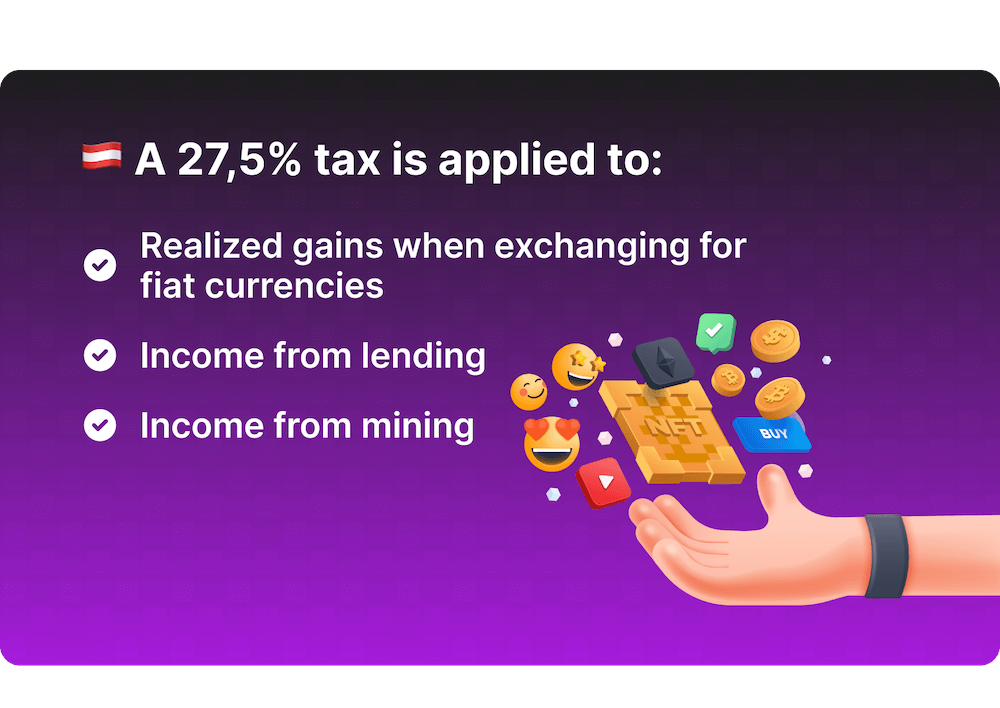
Yes, if you exchange cryptocurrencies for fiat money like the Euro and make a profit, a tax of 27.5% is applied to the gain. However, crypto-to-crypto exchanges remain tax-free.
<div class="card_body_small infobox margin-bottom_medium margin-top_small"><div class="flex_horizontal-copy gap-xxsmall margin-bottom_xxsmall"><div class="icon_small is-infobox w-embed"><svg xmlns="http://www.w3.org/2000/svg" width="24" height="24" viewBox="0 0 24 24" fill="none">
<path fill-rule="evenodd" clip-rule="evenodd" d="M2.25 12C2.25 6.61522 6.61522 2.25 12 2.25C17.3848 2.25 21.75 6.61522 21.75 12C21.75 17.3848 17.3848 21.75 12 21.75C6.61522 21.75 2.25 17.3848 2.25 12ZM10.9562 10.5584C12.1025 9.98533 13.3931 11.0206 13.0823 12.2639L12.3733 15.0999L12.4148 15.0792C12.7852 14.894 13.2357 15.0441 13.421 15.4146C13.6062 15.7851 13.4561 16.2356 13.0856 16.4208L13.0441 16.4416C11.8979 17.0147 10.6072 15.9794 10.9181 14.7361L11.6271 11.9001L11.5856 11.9208C11.2151 12.1061 10.7646 11.9559 10.5793 11.5854C10.3941 11.2149 10.5443 10.7644 10.9148 10.5792L10.9562 10.5584ZM12 9C12.4142 9 12.75 8.66421 12.75 8.25C12.75 7.83579 12.4142 7.5 12 7.5C11.5858 7.5 11.25 7.83579 11.25 8.25C11.25 8.66421 11.5858 9 12 9Z" fill="#1A73E8"></path>
</svg></div><div class="label"><span class="text_bold text-color-blue">Good to know</span></div></div><div class="label">Cryptocurrencies, including Bitcoin, Ether, and stablecoins like Tether, are defined as cryptocurrencies under § 27b Abs 4 EStG and are subject to these tax regulations. NFTs, on the other hand, are not considered cryptocurrencies, so different rules apply to them.</div></div>
What Is Old Stock (Altbestand) and New Stock (Neubestand) in Austria?
Since March 1, 2022, a new law has governed the taxation of cryptocurrencies in Austria, focusing on the purchase date of your assets:
- Cryptocurrencies purchased up to February 28, 2021 (old stock), can be sold tax-free after a one-year holding period, making all old stock now tax-exempt.
- Cryptocurrencies purchased after this date (new stock) are subject to a special tax rate of 27.5% when sold for fiat currency.
Special case: New stock cryptocurrencies sold before March 1, 2022, are subject to a progressive income tax rate of up to 55%.
<div class="card_body_small infobox margin-bottom_medium margin-top_small"><div class="flex_horizontal-copy gap-xxsmall margin-bottom_xxsmall"><div class="icon_small is-infobox w-embed"><svg xmlns="http://www.w3.org/2000/svg" width="24" height="24" viewBox="0 0 24 24" fill="none">
<path fill-rule="evenodd" clip-rule="evenodd" d="M2.25 12C2.25 6.61522 6.61522 2.25 12 2.25C17.3848 2.25 21.75 6.61522 21.75 12C21.75 17.3848 17.3848 21.75 12 21.75C6.61522 21.75 2.25 17.3848 2.25 12ZM10.9562 10.5584C12.1025 9.98533 13.3931 11.0206 13.0823 12.2639L12.3733 15.0999L12.4148 15.0792C12.7852 14.894 13.2357 15.0441 13.421 15.4146C13.6062 15.7851 13.4561 16.2356 13.0856 16.4208L13.0441 16.4416C11.8979 17.0147 10.6072 15.9794 10.9181 14.7361L11.6271 11.9001L11.5856 11.9208C11.2151 12.1061 10.7646 11.9559 10.5793 11.5854C10.3941 11.2149 10.5443 10.7644 10.9148 10.5792L10.9562 10.5584ZM12 9C12.4142 9 12.75 8.66421 12.75 8.25C12.75 7.83579 12.4142 7.5 12 7.5C11.5858 7.5 11.25 7.83579 11.25 8.25C11.25 8.66421 11.5858 9 12 9Z" fill="#1A73E8"></path>
</svg></div><div class="label"><span class="text_bold text-color-blue">Good to know</span></div></div><div class="label"><strong id="">Good to know:</strong> With the Eco-Social Tax Reform, crypto assets are treated as <strong id="">capitalassets</strong> for tax purposes. This means that cryptocurrencies are taxed like stocks, bonds, dividends, etc., and <strong id="">losses can be offset</strong> against gains from these other capital assets.</div></div>
How Much Tax Will You Have to Pay? (Example)
When you trade crypto for crypto, it does not trigger a tax liability, but the cost basis must be carried over. In a way, this allows you to defer taxation. Let's look at an example:
- Purchase of 1 BTC for 50,000€
- BTC rises to 70,000€
- Exchange of BTC for ETH (not a taxable event)
- The value of your ETH rises to 80,000€
- You sell half of it for 40,000€ (taxable)
How much tax will you have to pay?
To determine the tax due, subtract the cost basis from your sales proceeds. You sell half, so your cost basis is half of your original purchase cost of 1 BTC, which is 25,000€.
40,000€ - 25,000€ = 15,000€ profit.
27.5% of 15,000€ equals 4,125€ in taxes due.
<div class="card_body_small infobox green margin-bottom_medium margin-top_small"><div class="flex_horizontal gap-xxsmall margin-bottom_xxsmall"><div class="icon_small is-infobox w-embed"><svg xmlns="http://www.w3.org/2000/svg" width="24" height="24" viewBox="0 0 24 24" fill="none">
<path d="M7.49281 18.5C7.06823 18.5 6.67296 18.2635 6.51759 17.8684C6.18349 17.0187 6 16.0933 6 15.125C6 13.3759 6.59874 11.7667 7.60244 10.491C7.75335 10.2993 7.97456 10.1821 8.20214 10.094C8.67496 9.91091 9.09254 9.57968 9.4141 9.16967C10.1873 8.18384 11.1617 7.3634 12.2755 6.77021C12.9977 6.38563 13.6243 5.81428 13.9281 5.05464C14.1408 4.5231 14.25 3.95587 14.25 3.38338V2.75C14.25 2.33579 14.5858 2 15 2C16.2426 2 17.25 3.00736 17.25 4.25C17.25 5.40163 16.9904 6.49263 16.5266 7.46771C16.261 8.02604 16.6336 8.75 17.2519 8.75H20.3777C21.4044 8.75 22.3233 9.44399 22.432 10.4649C22.4769 10.8871 22.5 11.3158 22.5 11.75C22.5 14.5976 21.5081 17.2136 19.851 19.2712C19.4634 19.7525 18.8642 20 18.2462 20H14.2302C13.7466 20 13.2661 19.922 12.8072 19.7691L9.69278 18.7309C9.23393 18.578 8.75342 18.5 8.26975 18.5H7.49281Z" fill="#4CAF50"></path>
<path d="M2.33149 10.7271C1.79481 12.0889 1.5 13.5725 1.5 15.125C1.5 16.3451 1.68208 17.5226 2.02056 18.632C2.27991 19.482 3.10418 20 3.99289 20H4.90067C5.3462 20 5.62137 19.5017 5.42423 19.1022C4.83248 17.9029 4.5 16.5528 4.5 15.125C4.5 13.4168 4.97588 11.8198 5.8023 10.4593C6.0473 10.0559 5.77404 9.5 5.30212 9.5H4.24936C3.41733 9.5 2.63655 9.95303 2.33149 10.7271Z" fill="#4CAF50"></path>
</svg></div><div class="label"><span class="text_bold text-color-blue">Tip</span></div></div><div class="label">With <a id="" href="/crypto-tax-calculator">Blockpit's cryptocurrency tax software</a>, such calculations are fully automated for you. The days of tediously keeping track of your crypto transactions in an Excel file are over. Good riddance.</div></div>
Automatic KESt Deduction for Cryptocurrencies: Easier, but Not Always Sufficient
Since January 1, 2024, domestic providers like Bitpanda and Coinfinity automatically deduct the capital gains tax (KESt) for all individuals residing in Austria. This significantly reduces the effort for many investors. However, a tax return may still be necessary if:
- Missing or incorrect acquisition costs: Implausible entries result in flat-rate calculations that need to be corrected.
- Loss offsetting: Offsetting losses with other capital gains is only possible via a tax return.
- Non-automated platforms or DeFi: Profits from foreign platforms like Binance or DeFi income must be declared manually.
A crypto tax calculator helps track transactions, utilize losses, and calculate taxes correctly. This ensures compliance while maximizing tax benefits.
Do I Need to Pay Taxes on Cryptocurrency Income?
The key question is whether cryptocurrency income should be taxed upon receipt or only when it is sold or exchanged.
Income is taxed at the time of receipt in transactions where you transfer your cryptocurrencies to other market participants (e.g., to a network or company). This can occur in activities like mining, lending, staking, liquidity mining, yield farming, or liquidity providing. In such cases, the tax rate is 27.5%.
<div class="card_body_small infobox margin-bottom_medium margin-top_small"><div class="flex_horizontal-copy gap-xxsmall margin-bottom_xxsmall"><div class="icon_small is-infobox w-embed"><svg xmlns="http://www.w3.org/2000/svg" width="24" height="24" viewBox="0 0 24 24" fill="none">
<path fill-rule="evenodd" clip-rule="evenodd" d="M2.25 12C2.25 6.61522 6.61522 2.25 12 2.25C17.3848 2.25 21.75 6.61522 21.75 12C21.75 17.3848 17.3848 21.75 12 21.75C6.61522 21.75 2.25 17.3848 2.25 12ZM10.9562 10.5584C12.1025 9.98533 13.3931 11.0206 13.0823 12.2639L12.3733 15.0999L12.4148 15.0792C12.7852 14.894 13.2357 15.0441 13.421 15.4146C13.6062 15.7851 13.4561 16.2356 13.0856 16.4208L13.0441 16.4416C11.8979 17.0147 10.6072 15.9794 10.9181 14.7361L11.6271 11.9001L11.5856 11.9208C11.2151 12.1061 10.7646 11.9559 10.5793 11.5854C10.3941 11.2149 10.5443 10.7644 10.9148 10.5792L10.9562 10.5584ZM12 9C12.4142 9 12.75 8.66421 12.75 8.25C12.75 7.83579 12.4142 7.5 12 7.5C11.5858 7.5 11.25 7.83579 11.25 8.25C11.25 8.66421 11.5858 9 12 9Z" fill="#1A73E8"></path>
</svg></div><div class="label"><span class="text_bold text-color-blue">Good to know</span></div></div><div class="label">The 27.5% tax rate is applied when there is a "public placement," which is typically the case in the DeFi sector. If there is no "public placement," taxation is instead carried out according to the progressive income tax rate.</div></div>
However, income from (delegated) staking, airdrops, bounty or affiliate rewards, or hard forks is not taxed at the time of receipt, and the acquisition costs are set at zero.
Regardless, any profit made from the later sale of such income is always taxed at 27.5%.
How Can You Optimize Taxes on Crypto Gains?
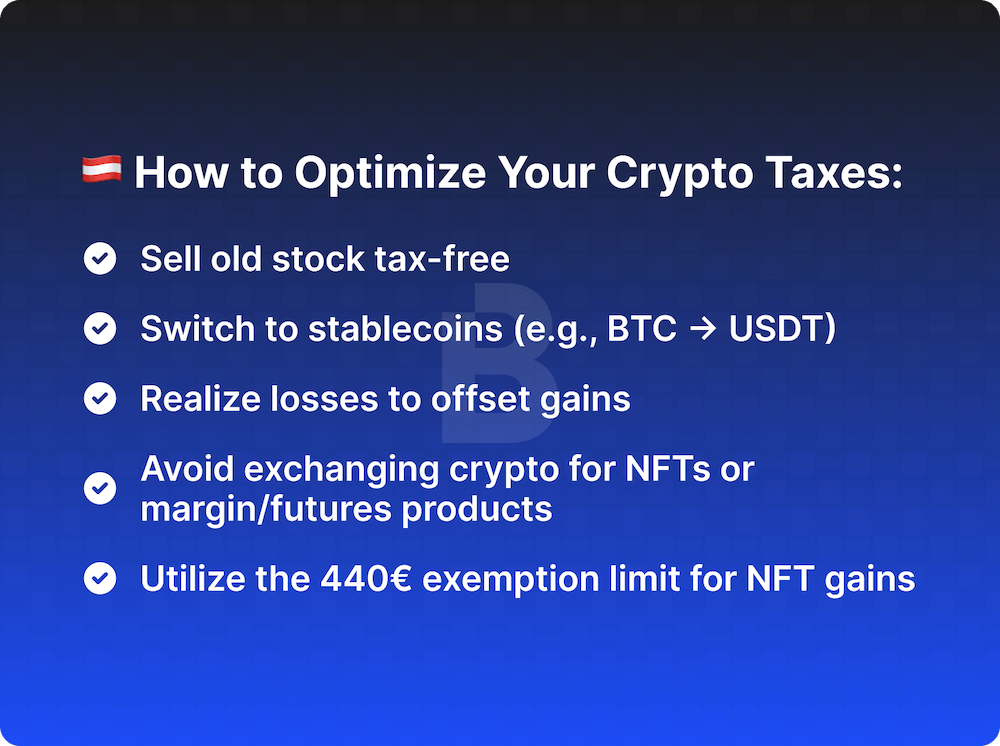
There are legal ways to minimize your tax burden on cryptocurrencies:
- Cryptocurrencies from old stock can be sold tax-free.
- Instead of exchanging cryptos for fiat currencies like EUR, you can convert them into stablecoins like USDT. This exchange is tax-free and protects against the high volatility of the crypto market while you enjoy the benefits of a stablecoin.
- You can offset crypto gains and losses with results from other capital market transactions (e.g., stocks, bonds, dividends, and derivatives) from the same tax year.
- Be aware: Profits from margin or futures trading are typically classified as income from unlisted derivatives and are subject to the progressive income tax rate. Crypto disposals occur simultaneously: Realized capital gains from these transactions are taxed at a fixed rate of 27.5%.
- Remember the exemption limit of 440€ per year on gains from NFTs to avoid tax liability.
<div class="card_body_small infobox green margin-bottom_medium margin-top_small"><div class="flex_horizontal gap-xxsmall margin-bottom_xxsmall"><div class="icon_small is-infobox w-embed"><svg xmlns="http://www.w3.org/2000/svg" width="24" height="24" viewBox="0 0 24 24" fill="none">
<path d="M7.49281 18.5C7.06823 18.5 6.67296 18.2635 6.51759 17.8684C6.18349 17.0187 6 16.0933 6 15.125C6 13.3759 6.59874 11.7667 7.60244 10.491C7.75335 10.2993 7.97456 10.1821 8.20214 10.094C8.67496 9.91091 9.09254 9.57968 9.4141 9.16967C10.1873 8.18384 11.1617 7.3634 12.2755 6.77021C12.9977 6.38563 13.6243 5.81428 13.9281 5.05464C14.1408 4.5231 14.25 3.95587 14.25 3.38338V2.75C14.25 2.33579 14.5858 2 15 2C16.2426 2 17.25 3.00736 17.25 4.25C17.25 5.40163 16.9904 6.49263 16.5266 7.46771C16.261 8.02604 16.6336 8.75 17.2519 8.75H20.3777C21.4044 8.75 22.3233 9.44399 22.432 10.4649C22.4769 10.8871 22.5 11.3158 22.5 11.75C22.5 14.5976 21.5081 17.2136 19.851 19.2712C19.4634 19.7525 18.8642 20 18.2462 20H14.2302C13.7466 20 13.2661 19.922 12.8072 19.7691L9.69278 18.7309C9.23393 18.578 8.75342 18.5 8.26975 18.5H7.49281Z" fill="#4CAF50"></path>
<path d="M2.33149 10.7271C1.79481 12.0889 1.5 13.5725 1.5 15.125C1.5 16.3451 1.68208 17.5226 2.02056 18.632C2.27991 19.482 3.10418 20 3.99289 20H4.90067C5.3462 20 5.62137 19.5017 5.42423 19.1022C4.83248 17.9029 4.5 16.5528 4.5 15.125C4.5 13.4168 4.97588 11.8198 5.8023 10.4593C6.0473 10.0559 5.77404 9.5 5.30212 9.5H4.24936C3.41733 9.5 2.63655 9.95303 2.33149 10.7271Z" fill="#4CAF50"></path>
</svg></div><div class="label"><span class="text_bold text-color-blue">Tip</span></div></div><div class="label"><strong id="">Pro Tip:</strong> With <a id="" href="/crypto-tax-optimization">Blockpit's Crypto Tax Optimizer</a>, included in <a id="" href="/blockpit-plus">Blockpit Plus</a>, you can easily identify tax-free gains. By the way, <a id="" href="/blockpit-plus">Blockpit Plus</a> is available for only 3,99€ monthly!</div></div>
What Is the Income Assessment and the Average Cost Basis (ACB)?
For tax purposes, the basis of assessment in the case of disposal is the difference between the sale proceeds and the acquisition costs, including any associated costs. That is the income assessment.
In the case of exchanging one cryptocurrency for another, the fair market value of the exchanged cryptocurrency is considered as the sale proceeds.
If cryptocurrencies are purchased sequentially and stored in the same cryptocurrency address, they must be valued according to the Average Cost Basis (ACB) as per the BMF Cryptocurrency Ordinance, and always in euros according to general tax principles.
Income from realized gains accruing from January 1, 2023, must be calculated using the ACB.
Items not included in the ACB:
- Old stock; if both old and new stocks are present, the taxpayer can choose how to allocate them at the time of disposal.
- Cryptocurrencies for which acquisition costs were set at a fixed rate during the capital gains tax deduction.
- For disposals on December 31, 2022, and earlier, the First In, First Out (FIFO) method or even a specific allocation of tranches—if clearly substantiable—is applicable.
How Do I File My Tax Return for Cryptocurrencies?
You can submit your tax return digitally via FinanzOnline or in paper form by mail. The Ministry of Finance provides an overview of relevant tax forms.
When Must I File My Tax Return for My Cryptocurrency Gains?
Generally, a tax return is always filed for the previous year. So, if you wish to file your tax return for 2024, you can do so starting in 2025. The submission method significantly affects the deadlines for annual tax returns in Austria:
- Earliest submission: Mid-February of the following year
- In paper form: Until April 30th of the following year
- Online: Until June 30th of the following year
- Via a tax advisor: Extensions can be requested

<div class="card_body_small infobox margin-bottom_medium margin-top_small"><div class="flex_horizontal-copy gap-xxsmall margin-bottom_xxsmall"><div class="icon_small is-infobox w-embed"><svg xmlns="http://www.w3.org/2000/svg" width="24" height="24" viewBox="0 0 24 24" fill="none">
<path fill-rule="evenodd" clip-rule="evenodd" d="M2.25 12C2.25 6.61522 6.61522 2.25 12 2.25C17.3848 2.25 21.75 6.61522 21.75 12C21.75 17.3848 17.3848 21.75 12 21.75C6.61522 21.75 2.25 17.3848 2.25 12ZM10.9562 10.5584C12.1025 9.98533 13.3931 11.0206 13.0823 12.2639L12.3733 15.0999L12.4148 15.0792C12.7852 14.894 13.2357 15.0441 13.421 15.4146C13.6062 15.7851 13.4561 16.2356 13.0856 16.4208L13.0441 16.4416C11.8979 17.0147 10.6072 15.9794 10.9181 14.7361L11.6271 11.9001L11.5856 11.9208C11.2151 12.1061 10.7646 11.9559 10.5793 11.5854C10.3941 11.2149 10.5443 10.7644 10.9148 10.5792L10.9562 10.5584ZM12 9C12.4142 9 12.75 8.66421 12.75 8.25C12.75 7.83579 12.4142 7.5 12 7.5C11.5858 7.5 11.25 7.83579 11.25 8.25C11.25 8.66421 11.5858 9 12 9Z" fill="#1A73E8"></path>
</svg></div><div class="label"><span class="text_bold text-color-blue">Good to know</span></div></div><div class="label">The deadlines for submitting tax returns online and in paper form can be extended upon a justified request. An extension request can be easily submitted electronically via <a id="" href="https://finanzonline.bmf.gv.at/fon/">FinanzOnline</a> (under "Weitere Services/Fristverlängerung"). Additional extensions are available for applications made through a tax advisor or corporate fiduciary.</div></div>
Crypto Tax Software: How Blockpit Automates Your Crypto Tax Filing
If you've ever filed a tax return, you know how much time can be spent on research, documentation, and preparation. Blockpit's legally compliant tax reports not only save you a great deal of time but also provide a comprehensive overview of all your crypto transactions, giving you exactly what you need: a legally compliant PDF that can be easily submitted to the tax office.
For full details, here is the complete PDF of our example crypto tax report.
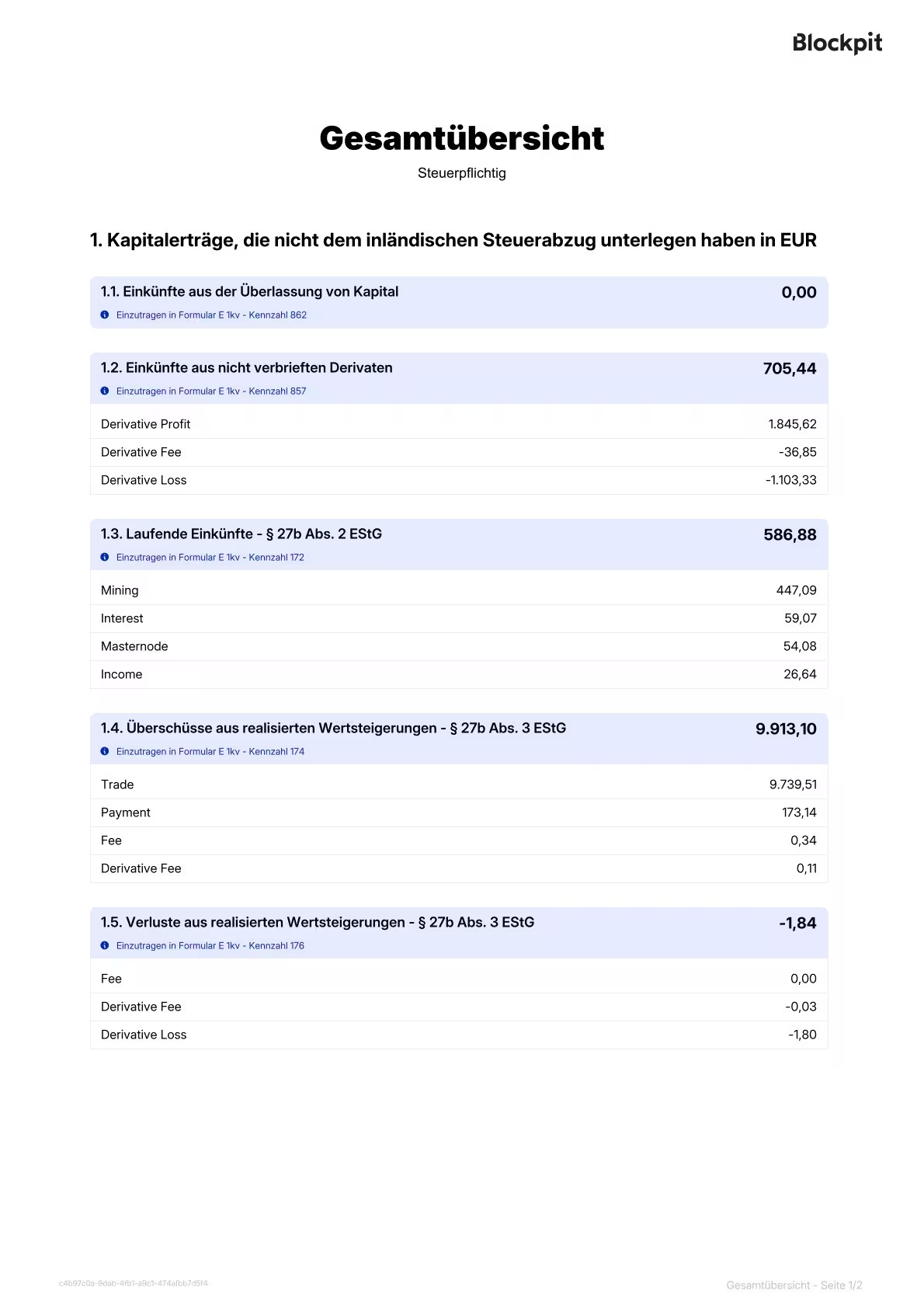
Overview of the Crypto Tax Report
Right from the start, you get an overview of your income from speculative transactions and services, as well as capital gains related to cryptocurrencies.
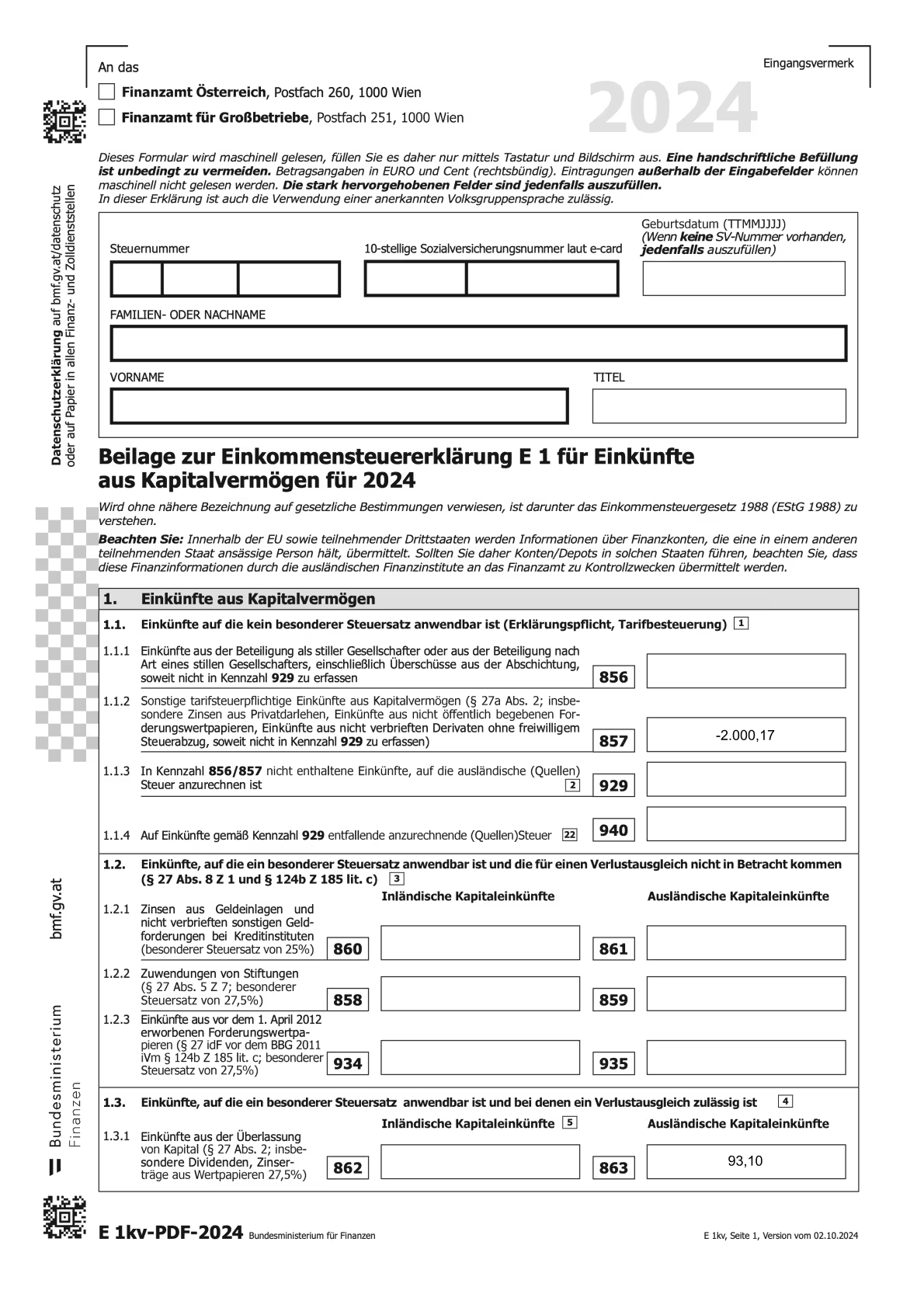
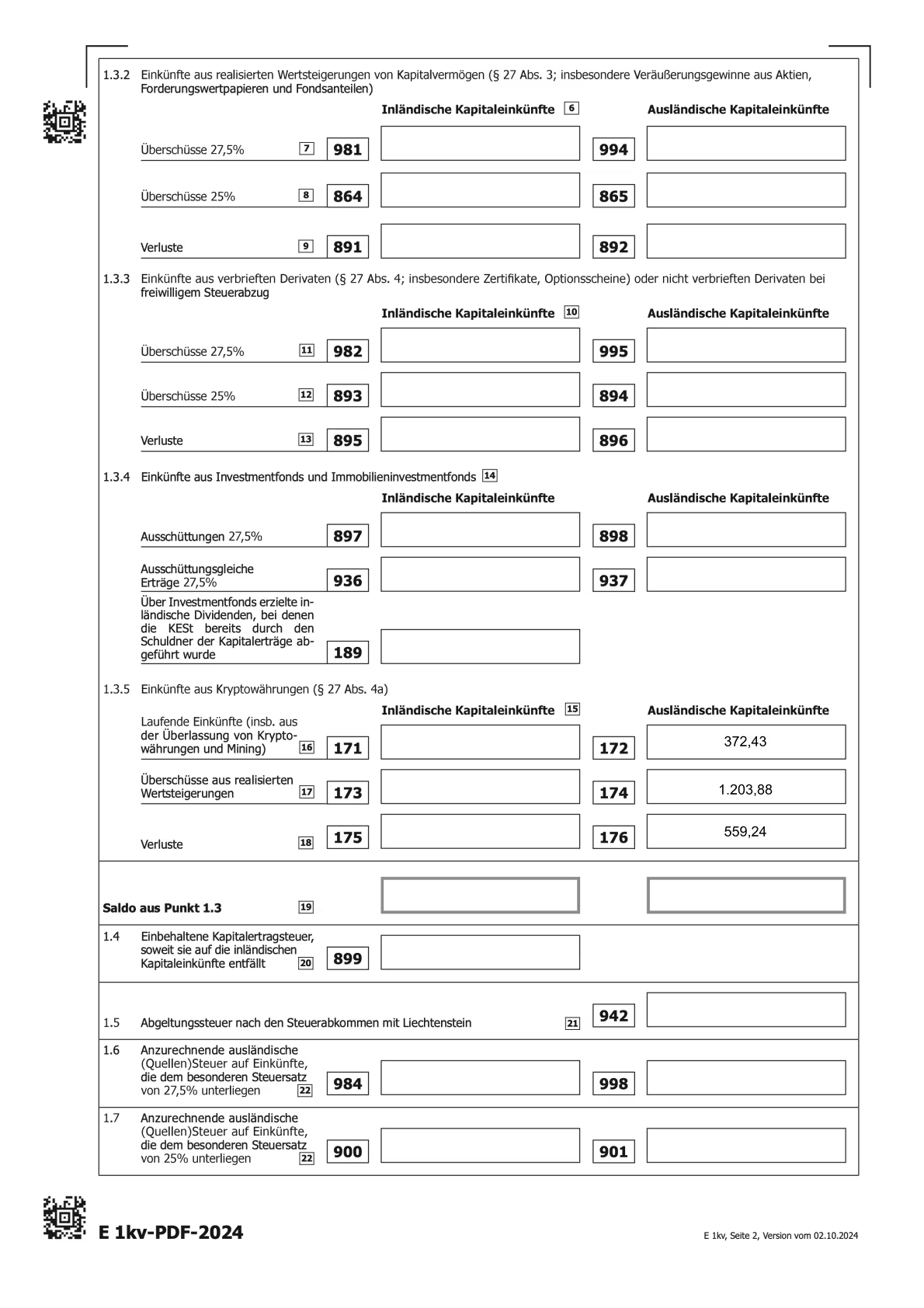
Income Tax Return Form
Next, you'll find the appropriate form from the Federal Ministry of Finance (BMF) for submitting your income tax return. Conveniently, Blockpit not only calculates the amounts you need to declare but also automatically enters them into the correct fields for you.
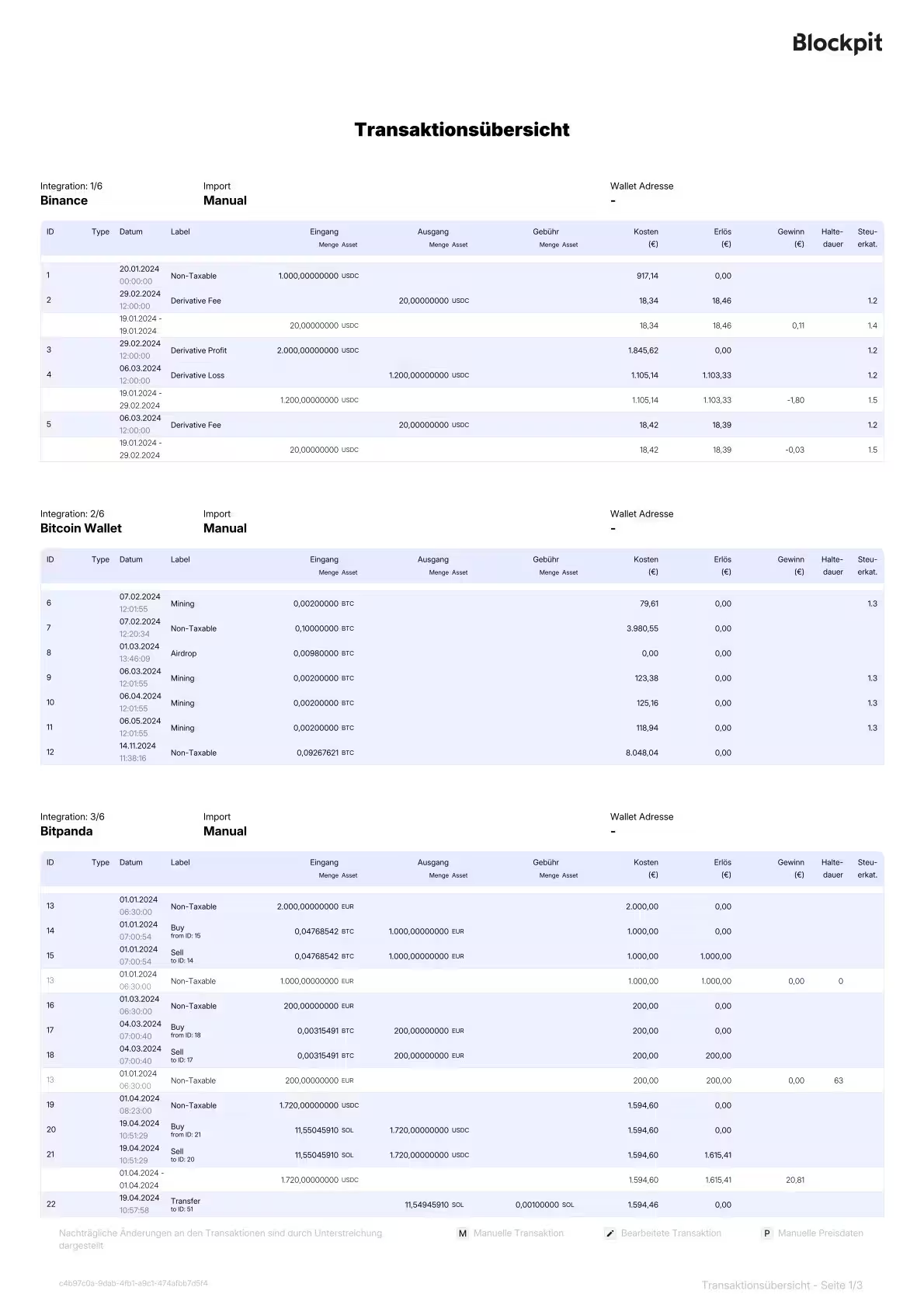
Detailed Transaction Listing
With a precise list of all your transactions, you can keep a complete record of your crypto activities throughout the year. This is excellent for manual checks and also serves as a helpful documentation tool for any inquiries you may receive.
When Are Crypto Transactions Tax-Free?
<figure class="block-table">
<table>
<thead>
<tr>
<th>Transaction</th>
<th>Key Info</th>
</tr>
</thead>
<tbody>
<tr>
<td>Legacy Holdings (Altbestand)</td>
<td>All assets purchased before 28 February 2021 are tax-free today.</td>
</tr>
<tr>
<td>Buying with Fiat</td>
<td>Acquiring cryptocurrency in exchange for euros or other fiat currencies.</td>
</tr>
<tr>
<td>Crypto-to-Crypto Swap</td>
<td>A direct swap between cryptocurrencies (e.g. BTC to ETH) does not trigger a taxable event.</td>
</tr>
<tr>
<td>Wallet Transfer</td>
<td>Transfers between your own wallets or exchange accounts are tax-neutral.</td>
</tr>
<tr>
<td>HODLing</td>
<td>Simply holding cryptocurrency without selling or swapping remains tax-free.</td>
</tr>
<tr>
<td>Gifts & Donations</td>
<td>Tax-free; reporting required for gifts to non-relatives above €15,000, and to relatives above €50,000.</td>
</tr>
<tr>
<td>Passive Income</td>
<td>Staking rewards, airdrops, bounties, and hard forks are only taxed upon disposal.</td>
</tr>
</tbody>
</table>
</figure>
Taxation of Basic Transactions
<figure class="block-table">
<table>
<thead>
<tr>
<th>Transaction</th>
<th>Tax</th>
<th>Key Info</th>
</tr>
</thead>
<tbody>
<tr>
<td>Crypto-to-Crypto Swap</td>
<td>Tax-free</td>
<td>Acquisition costs are carried over to the new asset.</td>
</tr>
<tr>
<td>Crypto to Fiat (Euro)</td>
<td>27.5%</td>
<td>Tax applies to the realised gain on disposal.</td>
</tr>
<tr>
<td>Airdrops</td>
<td>27.5% (on disposal)</td>
<td>Acquisition cost = €0; tax liability arises only upon disposal.</td>
</tr>
<tr>
<td>Bounty & Affiliate</td>
<td>27.5% (on disposal)</td>
<td>Received coins have an acquisition cost of €0; tax applies on disposal.</td>
</tr>
<tr>
<td>Mining (Private)</td>
<td>27.5%</td>
<td>Taxed upon receipt AND again on later disposal.</td>
</tr>
<tr>
<td>Hard Forks</td>
<td>27.5% (on disposal)</td>
<td>Tax-free upon receipt (value = €0); 27.5% tax only on disposal.</td>
</tr>
<tr>
<td>Futures Trading</td>
<td>Income Tax</td>
<td>Derivatives subject to progressive income tax rate (up to 55%) on closing.</td>
</tr>
<tr>
<td>Spot Margin Trading</td>
<td>27.5%</td>
<td>Trading with borrowed capital is treated as a standard crypto disposal event.</td>
</tr>
<tr>
<td>Transaction Fees</td>
<td>Deductible</td>
<td>Treated as acquisition costs and reduce taxable profit.</td>
</tr>
</tbody>
</table>
</figure>
Taxation of DeFi Transactions
<figure class="block-table">
<table>
<thead>
<tr>
<th>Transaction</th>
<th>Tax</th>
<th>Key Info</th>
</tr>
</thead>
<tbody>
<tr>
<td>Staking (On-Chain)</td>
<td>27.5% (on disposal)</td>
<td>Rewards are tax-free upon receipt (acquisition cost = €0); tax applies only on disposal.</td>
</tr>
<tr>
<td>Lending</td>
<td>27.5% (receipt + disposal)</td>
<td>Interest is taxed both upon receipt and again on later disposal.</td>
</tr>
<tr>
<td>Borrowing</td>
<td>Tax-free</td>
<td>Taking out a crypto-backed loan does not constitute a taxable event.</td>
</tr>
<tr>
<td>Liquidity Mining / Yield Farming</td>
<td>27.5% (receipt + disposal)</td>
<td>Rewards are taxable upon receipt; depositing into the pool is generally a tax-free swap.</td>
</tr>
<tr>
<td>Play to Earn</td>
<td>27.5% (receipt + disposal)</td>
<td>In-game rewards are taxable upon receipt and again on later disposal.</td>
</tr>
<tr>
<td>Learn to Earn</td>
<td>27.5% (receipt + disposal)</td>
<td>Rewards for completing educational courses are taxable upon receipt and on disposal.</td>
</tr>
</tbody>
</table>
</figure>
Frequently Asked Questions
How are crypto gains taxed in Austria?
Gains realised when cryptocurrency is exchanged for fiat money are generally taxed at the 27.5% special capital income tax rate. The treatment can differ for qualifying old holdings acquired before the new regime.
Are crypto-to-crypto swaps taxable in Austria?
Under the Austrian rules described in the guide, exchanging one cryptocurrency for another is generally tax-free. Tax is typically triggered when crypto is exchanged for fiat or used in another taxable transaction.
Do I declare my full crypto holdings or only gains and income?
The Austrian tax return generally reports taxable gains, deductible losses and crypto income rather than the full value of every holding. Complete transaction records should still be retained.
Can the Austrian tax authority identify crypto holdings and trades?
Yes. Exchanges collect KYC information and may provide data to authorities under applicable rules. CARF and DAC8 further expand the collection and international exchange of crypto account and transaction data.
What happens if crypto taxes are not reported in Austria?
Consequences can include back taxes, interest, financial penalties and, in serious cases, criminal proceedings. The guide recommends retaining complete crypto transaction records because authorities can investigate earlier tax years.