
In the US, the IRS treats cryptocurrency as property. This means every sale, trade, or exchange triggers a taxable event. Short-term gains (assets held under one year) are taxed at ordinary income rates of 10%–37%, while long-term gains (over one year) qualify for preferential rates of 0%, 15%, or 20%. This guide explains all IRS crypto tax rules for 2026.
How Much Is Crypto Taxed?
In the US, cryptocurrencies are taxed as property. You pay taxes on gains when you sell, trade, or dispose of them. Short-term capital gains (held less than a year) are taxed at income tax rates (10% to 37%), while long-term capital gains (held over a year) are taxed at reduced rates (0%, 15%, or 20%), based on your income.
What are Crypto Capital Gains and Capital Losses?
Crypto capital gains occur when you sell or exchange cryptocurrency for more than its purchase price, while capital losses occur when you sell for less. These must be reported on your tax return. Gains are taxed, while losses can offset other gains and up to 3,000$ of other income.
<div class="card_body_small infobox green margin-bottom_medium margin-top_small"><div class="flex_horizontal gap-xxsmall margin-bottom_xxsmall"><div class="icon_small is-infobox w-embed"><svg xmlns="http://www.w3.org/2000/svg" width="24" height="24" viewBox="0 0 24 24" fill="none">
<path d="M7.49281 18.5C7.06823 18.5 6.67296 18.2635 6.51759 17.8684C6.18349 17.0187 6 16.0933 6 15.125C6 13.3759 6.59874 11.7667 7.60244 10.491C7.75335 10.2993 7.97456 10.1821 8.20214 10.094C8.67496 9.91091 9.09254 9.57968 9.4141 9.16967C10.1873 8.18384 11.1617 7.3634 12.2755 6.77021C12.9977 6.38563 13.6243 5.81428 13.9281 5.05464C14.1408 4.5231 14.25 3.95587 14.25 3.38338V2.75C14.25 2.33579 14.5858 2 15 2C16.2426 2 17.25 3.00736 17.25 4.25C17.25 5.40163 16.9904 6.49263 16.5266 7.46771C16.261 8.02604 16.6336 8.75 17.2519 8.75H20.3777C21.4044 8.75 22.3233 9.44399 22.432 10.4649C22.4769 10.8871 22.5 11.3158 22.5 11.75C22.5 14.5976 21.5081 17.2136 19.851 19.2712C19.4634 19.7525 18.8642 20 18.2462 20H14.2302C13.7466 20 13.2661 19.922 12.8072 19.7691L9.69278 18.7309C9.23393 18.578 8.75342 18.5 8.26975 18.5H7.49281Z" fill="#4CAF50"></path>
<path d="M2.33149 10.7271C1.79481 12.0889 1.5 13.5725 1.5 15.125C1.5 16.3451 1.68208 17.5226 2.02056 18.632C2.27991 19.482 3.10418 20 3.99289 20H4.90067C5.3462 20 5.62137 19.5017 5.42423 19.1022C4.83248 17.9029 4.5 16.5528 4.5 15.125C4.5 13.4168 4.97588 11.8198 5.8023 10.4593C6.0473 10.0559 5.77404 9.5 5.30212 9.5H4.24936C3.41733 9.5 2.63655 9.95303 2.33149 10.7271Z" fill="#4CAF50"></path>
</svg></div><div class="label"><span class="text_bold text-color-blue">Tip</span></div></div><div class="label">Blockpit's <a href="/crypto-portfolio-tracker">free crypto portfolio tracker</a> takes care of record keeping for you. Automatically import transactions from exchanges and wallets and let the portfolio tracker handle the rest.</div></div>
Crypto Capital Gains Tax Rates

<div class="card_body_small infobox margin-bottom_medium margin-top_small"><div class="flex_horizontal-copy gap-xxsmall margin-bottom_xxsmall"><div class="icon_small is-infobox w-embed"><svg xmlns="http://www.w3.org/2000/svg" width="24" height="24" viewBox="0 0 24 24" fill="none">
<path fill-rule="evenodd" clip-rule="evenodd" d="M2.25 12C2.25 6.61522 6.61522 2.25 12 2.25C17.3848 2.25 21.75 6.61522 21.75 12C21.75 17.3848 17.3848 21.75 12 21.75C6.61522 21.75 2.25 17.3848 2.25 12ZM10.9562 10.5584C12.1025 9.98533 13.3931 11.0206 13.0823 12.2639L12.3733 15.0999L12.4148 15.0792C12.7852 14.894 13.2357 15.0441 13.421 15.4146C13.6062 15.7851 13.4561 16.2356 13.0856 16.4208L13.0441 16.4416C11.8979 17.0147 10.6072 15.9794 10.9181 14.7361L11.6271 11.9001L11.5856 11.9208C11.2151 12.1061 10.7646 11.9559 10.5793 11.5854C10.3941 11.2149 10.5443 10.7644 10.9148 10.5792L10.9562 10.5584ZM12 9C12.4142 9 12.75 8.66421 12.75 8.25C12.75 7.83579 12.4142 7.5 12 7.5C11.5858 7.5 11.25 7.83579 11.25 8.25C11.25 8.66421 11.5858 9 12 9Z" fill="#1A73E8"></path>
</svg></div><div class="label"><span class="text_bold text-color-blue">Good to know</span></div></div><div class="label"><strong>Blockpit Tip</strong>: Take advantage of lower long-term capital gains tax rates by holding crypto for over a year.</div></div>
Short-Term Capital Gains Tax Rates for 2024
Short-term capital gains (assets held for less than one year) are taxed at your ordinary income tax rate. See the details in the table below:
<figure class="block-table">
<table>
<tr>
<th>Tax Rate</th>
<th>Single</th>
<th>Head of Household</th>
<th>Married Filing Jointly</th>
<th>Married Filing Separately</th>
</tr>
<tr>
<td>10%</td>
<td>Up to $11,600</td>
<td>Up to $16,550</td>
<td>Up to $23,200</td>
<td>Up to $11,600</td>
</tr>
<tr>
<td>12%</td>
<td>$11,601 to $47,150</td>
<td>$16,551 to $63,100</td>
<td>$23,201 to $94,300</td>
<td>$11,601 to $47,150</td>
</tr>
<tr>
<td>22%</td>
<td>$47,151 to $100,525</td>
<td>$63,101 to $100,500</td>
<td>$94,301 to $201,050</td>
<td>$47,151 to $100,525</td>
</tr>
<tr>
<td>24%</td>
<td>$100,526 to $191,950</td>
<td>$100,501 to $191,950</td>
<td>$201,051 to $383,900</td>
<td>$100,526 to $191,950</td>
</tr>
<tr>
<td>32%</td>
<td>$191,951 to $243,725</td>
<td>$191,951 to $243,700</td>
<td>$383,901 to $487,450</td>
<td>$191,951 to $243,725</td>
</tr>
<tr>
<td>35%</td>
<td>$243,726 to $609,350</td>
<td>$243,701 to $609,350</td>
<td>$487,451 to $731,200</td>
<td>$243,726 to $365,600</td>
</tr>
<tr>
<td>37%</td>
<td>Over $609,350</td>
<td>Over $609,350</td>
<td>Over $731,200</td>
<td>Over $365,600</td>
</tr>
</table>
</figure>
Long-Term Capital Gains Tax Rates for 2024
Long-term capital gains (assets held for more than one year) are taxed at a lower rate, ranging from 0% to 20% based on your income. See details in the table below:
<figure class="block-table">
<table>
<tr>
<th>Tax Rate</th>
<th>Single</th>
<th>Head of Household</th>
<th>Married filing jointly</th>
<th>Married filing separately</th>
</tr>
<tr>
<td>15%</td>
<td>47,026$ – 518,900$</td>
<td>63,001$ – 551,350$</td>
<td>94,051$ – 583,750$</td>
<td>47,026$ – 291,850$</td>
</tr>
<tr>
<td>20%</td>
<td>≥ 518,900$</td>
<td>≥ 551,350$</td>
<td>≥ 583,750$</td>
<td>≥ 291,850$</td>
</tr>
</table>
</figure>
How Do Crypto Tax Brackets Work?
Tax brackets are income ranges that determine tax rates. The US uses a progressive tax system, where higher income is taxed at higher rates. Here's how it works:
- Income Divisions: Taxable income is divided into segments, or brackets.
- Progressive Rates: Each bracket has a different tax rate, increasing with higher income.
- Marginal Taxation: Only income within a specific bracket is taxed at that bracket's rate.
- Tax Calculation: Apply the tax rate for each bracket to the income within that bracket, then sum up the taxes for the total owed.
Example: Tax Brackets
For 2024, the US has seven federal income tax brackets (see table above). If you earn 50,000$ as a single filer, your income falls into three brackets:
- 11,600$ at 10% = 1,160$
- 35,549$ at 12% = 4,266$
- 2,850$ at 22% = 627$
Total tax bill = 6,053$
Your effective tax rate would be approximately 12%, even though your highest tax bracket is 22%.
How to Calculate Crypto Capital Gains and Cost Basis
To calculate crypto capital gains, find the cost basis and fair market value (FMV) at the time of the taxable event (e.g., selling or trading). Use the formula:
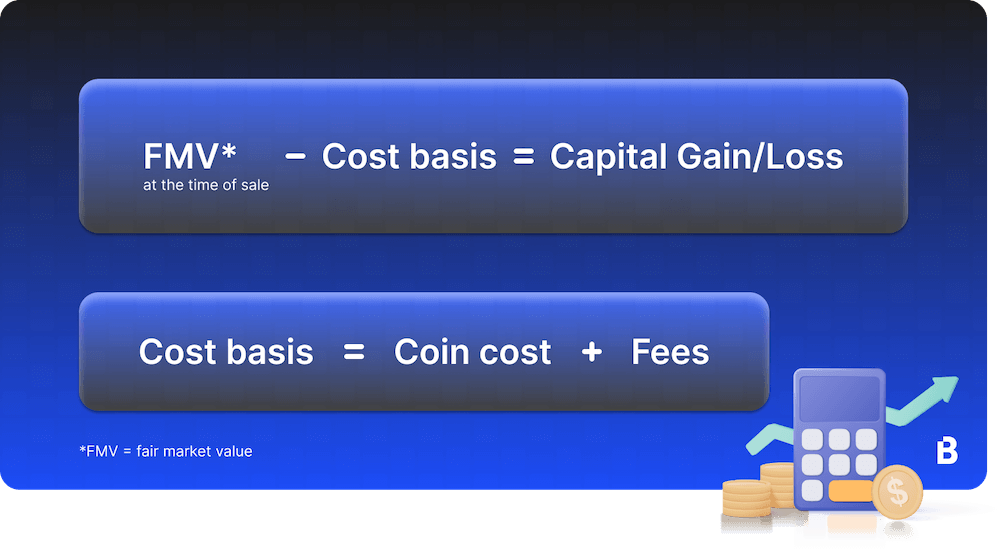
Keep accurate records of all transactions, including dates, amounts, FMV, and cost basis, to ensure correct calculations.
Blockpit’s crypto portfolio tracker collects, tracks and organizes all the necessary records you need for your crypto tax report. Try it now for free!
Crypto Tax Deadlines in the US

The tax deadline for crypto transactions is the same as for traditional investments. Here are the critical deadlines to keep in mind:
- April 15: Tax filing deadline for most individuals. Report crypto income on your tax return.
- June 15: Deadline for US citizens and residents living abroad.
- October 15: Final deadline if you filed for an extension.
Optimizing Your Cryptocurrency Taxes
To reduce your crypto taxes in the US, consider these strategies:
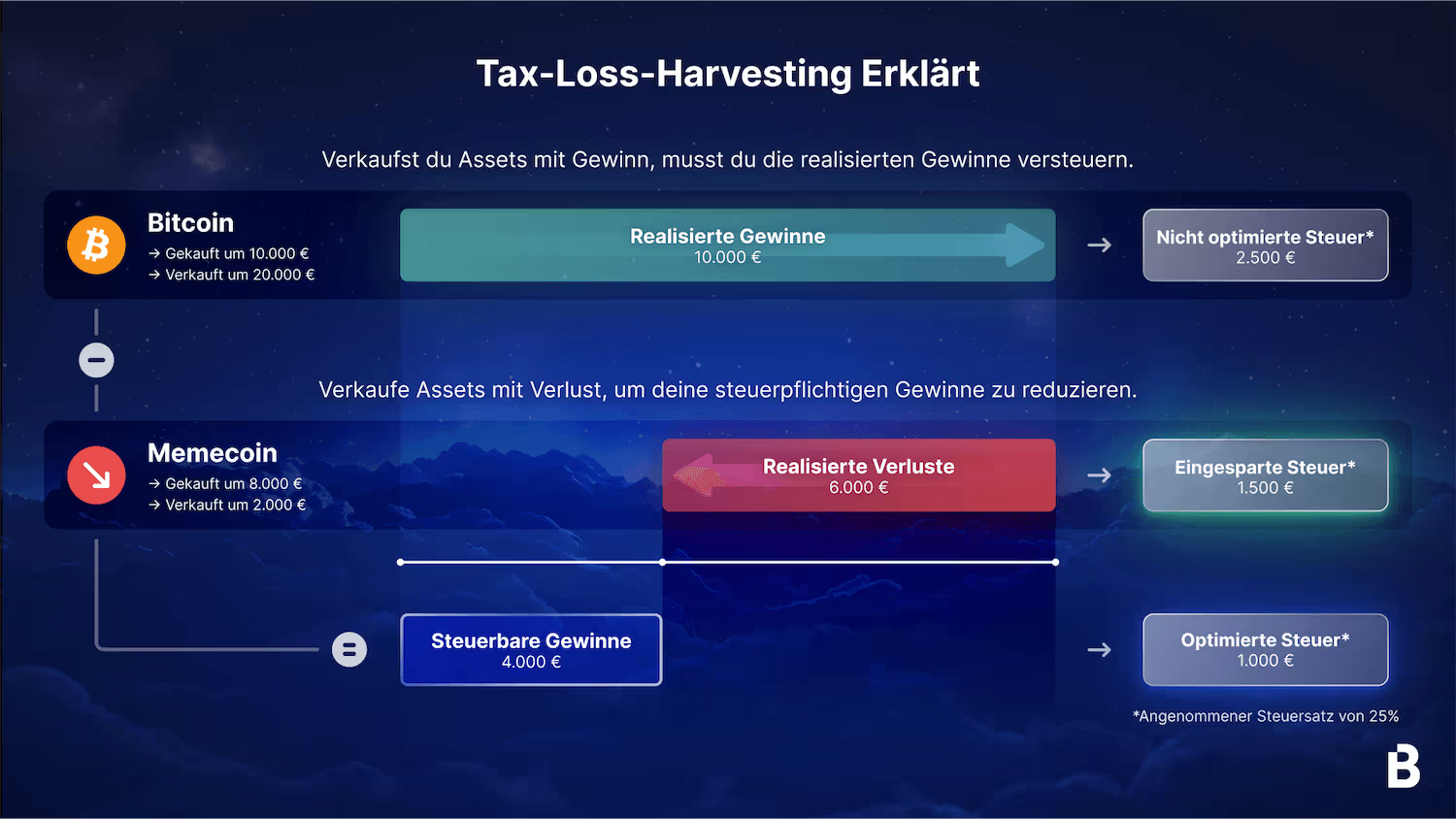
- Tax-Loss Harvesting: Offset capital gains with capital losses to reduce tax liability. Follow IRS guidelines.
- Holding Period (HODL): Hold crypto assets for over a year to benefit from lower long-term capital gains tax rates.
- Capital Gains Tax (CGT) Allowance: Profits from crypto transactions are subject to capital gains taxes. If your total taxable income is less than 44,625$ (single or married filing separately) or 89,250$ (married filing jointly) or 59,750$ (head of household) in 2023, you may pay no tax on capital gains.
- Maximizing Deductions: Deduct expenses related to crypto mining or business activities. Keep detailed records and consult a tax professional.
- Pick the Right Cost Basis Method: Choose a cost basis method (FIFO, HIFO, Specific Identification) that minimizes tax liability. Consult a tax professional to determine the best method.
- Invest in IRAs: Use traditional or Roth IRAs (tax-advantaged retirement accounts) for crypto investments to gain tax benefits. Be aware of restrictions and regulations.
- Charitable Donations: Donate crypto to a qualified charity for a tax deduction based on the fair market value.
<div class="card_body_small infobox green margin-bottom_medium margin-top_small"><div class="flex_horizontal gap-xxsmall margin-bottom_xxsmall"><div class="icon_small is-infobox w-embed"><svg xmlns="http://www.w3.org/2000/svg" width="24" height="24" viewBox="0 0 24 24" fill="none">
<path d="M7.49281 18.5C7.06823 18.5 6.67296 18.2635 6.51759 17.8684C6.18349 17.0187 6 16.0933 6 15.125C6 13.3759 6.59874 11.7667 7.60244 10.491C7.75335 10.2993 7.97456 10.1821 8.20214 10.094C8.67496 9.91091 9.09254 9.57968 9.4141 9.16967C10.1873 8.18384 11.1617 7.3634 12.2755 6.77021C12.9977 6.38563 13.6243 5.81428 13.9281 5.05464C14.1408 4.5231 14.25 3.95587 14.25 3.38338V2.75C14.25 2.33579 14.5858 2 15 2C16.2426 2 17.25 3.00736 17.25 4.25C17.25 5.40163 16.9904 6.49263 16.5266 7.46771C16.261 8.02604 16.6336 8.75 17.2519 8.75H20.3777C21.4044 8.75 22.3233 9.44399 22.432 10.4649C22.4769 10.8871 22.5 11.3158 22.5 11.75C22.5 14.5976 21.5081 17.2136 19.851 19.2712C19.4634 19.7525 18.8642 20 18.2462 20H14.2302C13.7466 20 13.2661 19.922 12.8072 19.7691L9.69278 18.7309C9.23393 18.578 8.75342 18.5 8.26975 18.5H7.49281Z" fill="#4CAF50"></path>
<path d="M2.33149 10.7271C1.79481 12.0889 1.5 13.5725 1.5 15.125C1.5 16.3451 1.68208 17.5226 2.02056 18.632C2.27991 19.482 3.10418 20 3.99289 20H4.90067C5.3462 20 5.62137 19.5017 5.42423 19.1022C4.83248 17.9029 4.5 16.5528 4.5 15.125C4.5 13.4168 4.97588 11.8198 5.8023 10.4593C6.0473 10.0559 5.77404 9.5 5.30212 9.5H4.24936C3.41733 9.5 2.63655 9.95303 2.33149 10.7271Z" fill="#4CAF50"></path>
</svg></div><div class="label"><span class="text_bold text-color-blue">Tip</span></div></div><div class="label">Access <a href="https://www.blockpit.io/en-us/crypto-tax-optimization">Blockpit’s Crypto Tax Optimizer</a> for seamless Tax Loss Harvesting, with visual insights into unrealized gains, tax-free assets, and an upcoming Sell Simulation feature - available exclusively at Blockpit.</div></div>
Be aware of specific tax rules: The wash sale rule prohibits investors from deducting a loss on the sale of a security if they buy back the same or a substantially identical asset within a specified timeframe, usually a 30-day window before or after the sale. In the U.S., this rule currently does not apply to cryptocurrencies, though changes may be on the horizon. To stay compliant, avoid repurchasing the same assets immediately.
How to File Your Crypto Tax Return
For US tax returns involving cryptocurrency, familiarize yourself with necessary forms:
- Form 1040: The primary form for individual annual income tax returns, including income, deductions, and credits. Use it to report your overall income, including capital gains or losses from crypto transactions.
- Schedule D: Reports capital gains and losses from asset sales or exchanges, such as cryptocurrencies. Transfer the information from Form 8949 to Schedule D.
- Form 8949: Required for reporting multiple capital gains or losses on Schedule D, providing detailed transaction information. Use this form to report your capital gains or losses from your crypto transactions.
- Form 1099-K: Issued by cryptocurrency exchanges to users exceeding certain transaction volume and gross receipt thresholds, summarizing yearly payments.
- Form 1099-B: Provided by brokers or intermediaries to report cryptocurrency sales and related details.
- NEW: Form 1099-DA: Starting January 1, 2025, cryptocurrency brokers, including exchanges and payment processors, are mandated to report users' sales and exchanges of digital assets to the IRS using the newly developed Form 1099-DA.
The specific forms needed vary based on the nature and volume of your cryptocurrency transactions and your particular tax situation.
The IRS can audit tax returns up to six years back. Blockpit's free crypto portfolio tracker helps you keep essential records (date, type, amount, cost basis, profit, fees, etc.) organized. Try it now for free!
How to File Your Taxes With Blockpit
Tired of manually entering all your trades into Form 8949? We've got you covered! As Europe's leading crypto tax firm, Blockpit's crypto tax calculator offers acclaimed tax reports and pre-filled forms tailored for the United States. Our crypto tax software simplifies generating tax reports by importing transaction data from exchanges and wallets, automatically calculating capital gains or losses. It provides real-time tax calculations and shows unrealized gains or losses.
Want to see all the details? Check out the complete PDF of our crypto tax sample report.
File Your Crypto Taxes With TaxAct
TaxAct is a tax preparation software with a dedicated crypto tax importer. It simplifies filing crypto taxes by importing transaction data from exchanges and wallets, calculating gains and losses, and generating accurate tax forms.
File Your Crypto Taxes With TurboTax
TurboTax offers a crypto tax solution with a step-by-step guide, integration with tax forms, audit protection, and expert support. It’s ideal for those who prefer to file taxes independently or have mixed income sources. However, if you’ve already used Blockpit for crypto tax calculations, TurboTax may add little value.
Use Blockpit's crypto tax software to track transactions, calculate gains and losses, and generate tax reports. Import these reports into TurboTax (Online or Desktop) for a simpler and more efficient filing process.
Capital Gains Tax Events
<figure class="block-table">
<table>
<thead>
<tr>
<th>Transaction</th>
<th>Tax</th>
<th>Key Info</th>
</tr>
</thead>
<tbody>
<tr>
<td>Selling Crypto for Fiat</td>
<td>Capital Gains Tax</td>
<td>Selling cryptocurrency for fiat currency triggers a taxable event. Report any gains or losses, calculated as the difference between the sale price and purchase cost (cost basis).</td>
</tr>
<tr>
<td>Buying Goods and Services Using Cryptocurrencies</td>
<td>Capital Gains Tax</td>
<td>Using crypto to buy goods or services is taxable. Report gains or losses based on the difference between the purchase cost and the market value at the time of the transaction.</td>
</tr>
<tr>
<td>Trading One Crypto for Another</td>
<td>Capital Gains Tax</td>
<td>Trading one cryptocurrency for another is a taxable event. Calculate gains or losses as the difference between the original purchase cost and the fair market value at the time of the trade.</td>
</tr>
<tr>
<td>Crypto Margin Trading, Futures and Other CFDs</td>
<td>Capital Gains Tax</td>
<td>These activities are taxed on the difference between the cost basis and the fair market value at the time of the trade. Report gains or losses accordingly.</td>
</tr>
<tr>
<td>NFTs</td>
<td>Capital Gains Tax</td>
<td>Selling NFTs is subject to capital gains tax. Short-term gains (held less than a year) are taxed as ordinary income, while long-term gains (held over a year) are taxed at lower rates.</td>
</tr>
</tbody>
</table>
</figure>
Income Tax Events
<figure class="block-table">
<table>
<thead>
<tr>
<th>Transaction</th>
<th>Tax</th>
<th>Key Info</th>
</tr>
</thead>
<tbody>
<tr>
<td>Receiving Cryptocurrency as Salary</td>
<td>Income Tax</td>
<td>The value of cryptocurrency received as salary is reported as income on the W-2 form. Any subsequent gains or losses are subject to capital gains tax.</td>
</tr>
<tr>
<td>Receiving Cryptocurrency in Exchange for Goods and Services</td>
<td>Income Tax</td>
<td>Crypto received for goods or services is taxed as ordinary income based on its fair market value at the time of the transaction.</td>
</tr>
<tr>
<td>Staking Rewards</td>
<td>Income Tax</td>
<td>Staking rewards are taxable income at their fair market value when received. Accurate record-keeping is essential.</td>
</tr>
<tr>
<td>DeFi Transactions</td>
<td>Income Tax / Capital Gains Tax</td>
<td>Income from DeFi activities, such as earning extra tokens, is taxable.</td>
</tr>
<tr>
<td>Mining Rewards</td>
<td>Income Tax</td>
<td>Mining rewards are taxable income at their market value when received, and may be reported as self-employment or miscellaneous income. Miners can deduct related expenses.</td>
</tr>
<tr>
<td>Airdrops</td>
<td>Income Tax</td>
<td>Airdropped cryptocurrencies are taxed at their fair market value on the receipt date and must be reported as income.</td>
</tr>
<tr>
<td>Hard Forks</td>
<td>Income Tax</td>
<td>New cryptocurrencies received from hard forks are considered taxable income at their market value when received. Future sales may incur capital gains tax.</td>
</tr>
<tr>
<td>Referral Bonuses</td>
<td>Income Tax</td>
<td>Referral bonuses in crypto are taxable income at their market value when received. Keep detailed records for accurate tax reporting.</td>
</tr>
<tr>
<td>Other Crypto Rewards (Learn to Earn, Play to Earn, etc.)</td>
<td>Income Tax</td>
<td>Crypto rewards from various activities are taxable income at their fair market value.</td>
</tr>
</tbody>
</table>
</figure>
Non-Taxable Events
It is important to note that while these events may not trigger a tax liability, they may still need to be reported on your tax return for record-keeping purposes.
<figure class="block-table">
<table>
<thead>
<tr>
<th>Transaction</th>
<th>Key Info</th>
</tr>
</thead>
<tbody>
<tr>
<td>Buying Crypto with Fiat Money (Cash)</td>
<td>Purchasing cryptocurrency with cash is not taxable, but future transactions involving the crypto may be.</td>
</tr>
<tr>
<td>HODLing Crypto</td>
<td>Simply holding crypto does not trigger taxes; selling or exchanging it does.</td>
</tr>
<tr>
<td>Crypto Donations</td>
<td>Donating crypto to a recognized nonprofit is not taxable and is tax-deductible based on its market value. The charity must have 501(c)(3) status. Complete Form 8283 for donations over $500. Obtain a qualified appraisal for donations over $5,000.</td>
</tr>
<tr>
<td>Receiving Crypto as a Gift</td>
<td>Receiving crypto as a gift is not taxable. The recipient inherits the giver's cost basis.</td>
</tr>
<tr>
<td>Giving Crypto as a Gift</td>
<td>Under the annual gift tax exclusion, up to $17,000 (2023) can be gifted tax-free per person annually.</td>
</tr>
<tr>
<td>Transferring Crypto Between Wallets</td>
<td>Moving crypto between your own wallets is not taxable.</td>
</tr>
<tr>
<td>Using Crypto as Collateral for a Loan</td>
<td>Using crypto as loan collateral is not taxable unless the lender seizes the crypto.</td>
</tr>
</tbody>
</table>
</figure>
Tax-Deductible Events
<figure class="block-table">
<table>
<thead>
<tr>
<th>Transaction</th>
<th>Key Info</th>
</tr>
</thead>
<tbody>
<tr>
<td><strong>Crypto Losses</strong></td>
<td>Losses can offset capital gains and up to $3,000 against ordinary income per year. Excess losses can be carried forward to future tax years. The strategic use of crypto losses to reduce your tax burden is known as <strong>Tax Loss Harvesting</strong>.</td>
</tr>
<tr>
<td><strong>Crypto Fees</strong></td>
<td><strong>Transfer fees</strong> (e.g. sending crypto between wallets) are generally <strong>not deductible</strong>. <strong>Trading fees</strong> paid when buying or selling crypto can be added to the cost basis or deducted from proceeds, effectively reducing your taxable gain.</td>
</tr>
<tr>
<td><strong>Lost or Stolen Cryptocurrencies</strong></td>
<td>Under the <strong>Tax Cuts and Jobs Act (TCJA)</strong>, personal casualty and theft losses are no longer deductible for tax years 2018–2025. Lost or stolen crypto cannot be claimed as a deduction unless the loss is tied to a federally declared disaster.</td>
</tr>
<tr>
<td><strong>Exchange Bankruptcies</strong></td>
<td>Losses from assets held on a bankrupt exchange can potentially be treated as <strong>capital losses</strong> once the loss is considered realized (e.g. the exchange ceases operations or a recovery is deemed unlikely). These losses can then be used to offset capital gains.</td>
</tr>
</tbody>
</table>
</figure>
Frequently Asked Questions
Can the IRS track cryptocurrency?
Yes, the IRS monitors transactions through 1099 forms from exchanges, partnerships with firms like Chainalysis, and subpoenas. Increased scrutiny makes omission difficult.
What happens if you don’t report your crypto gains?
Not reporting can lead to severe penalties, including fines up to 75% of unpaid tax, interest charges, criminal prosecution, and potential imprisonment. Consult a tax professional if you receive an IRS warning.
Which crypto exchanges report to the IRS?
All US exchanges must report under the Bank Secrecy Act. Major exchanges like Coinbase, Gemini, Kraken, and Bitstamp provide information to the IRS.
What is the difference between short-term and long-term crypto capital gains in the US?
Short-term gains (crypto held less than 12 months) are taxed as ordinary income at rates from 10% to 37%. Long-term gains (held over 12 months) are taxed at preferential rates of 0%, 15%, or 20% depending on your total taxable income — making the one-year holding period highly valuable for US investors.
Is crypto taxed like stocks?
No, crypto is treated as property, not stocks or currency. Capital gains and losses are taxed like other property.